|
SIR ALFRED MUNNINGS AND THE MILITARY
by Christopher Joll
Late The Life Guards
|
From November 2018 to March 2019 the National Army Museum, in partnership with the Canadian War Museum and The Munnings Art Museum, staged an exhibition of the work of Sir Alfred Munnings KCVO PRA.
Best known for his civilian equestrian portraits, for the closing two years of the First World War, Munnings was attached to the Canadian Cavalry Brigade, during which time he produced many canvasses. These included Charge of Flowerdew’s Squadron, which depicts the last great cavalry charge of the war on 30th March 1918 at Moreuil Wood, where C Squadron of Lord Strathcona’s Horse, led by Lieutenant Gordon Flowerdew, halted the advance of five German infantry companies supported by artillery and machine guns. The squadron suffered more than fifty percent fatalities, including Flowerdew, who was awarded a posthumous Victoria Cross.
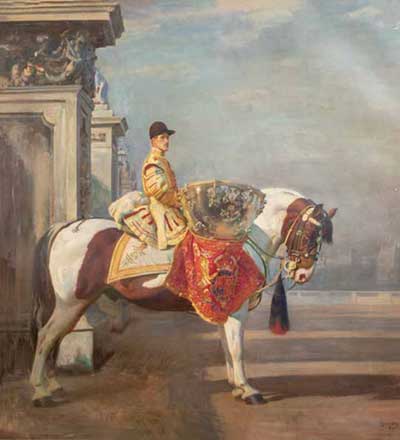 The Drummer of His Majesty’s First Life Guards. 1922.
A J Munnings. The Life Guards Serving Officers’ Trust
The Drummer was George Carter, who joined the 1st Life Guards Band in 1919 and served until 1927 |
Missing from the exhibition, presumably because of their dates, are two post-war military paintings by Munnings in the collection of The Life Guards: Presentation of Standards to the Household Cavalry by King George V (1927) and Drum Horse (1922). The latter is an enormous canvas which currently hangs in the ante-room of the Officers’ House at Hyde Park Barracks. Commissioned by Lieutenant Colonel Sir George Holford KCVO CIE CBE, a former Commanding Officer of the 1st Life Guards, it depicts the regiment’s drum horse, Paddy II, which itself had been presented by Sir George to the 1st Life Guards in 1916. It is clear that Sir George’s intention was to memorialise his earlier gift with the Munnings painting but, before it could be completed, the 1st and 2nd Life Guards had undergone a very tetchy amalgamation. Nonetheless, Sir George presented the canvas to the new regiment, in which Paddy II still served, albeit no longer tacked-up with a 1st Life Guards shabraque as depicted in the painting.
Drum horses have been ‘on the strength’ of the Household Cavalry since its formation around the time of the Restoration of the Monarchy in 1660. Contemporary engravings establish that, at the Coronation Procession of King Charles II in 1661, His Majesty’s Troops of Horse Guards were each led by a kettledrummer. However, the use of kettledrums by the British Cavalry of the Line was not authorised until 1729 when kettledrummers were officially included in all British cavalry regiments’ establishments. This was just as well because, fourteen years later, two pairs of kettledrums were captured from the French at the Battle of Dettingen by British regiments and subsequently used on parade: a pair of copper kettledrums belonging to a French Gendarmes Regiment were seized by Ligonier’s Horse (now the Royal Dragoon Guards) and a pair of silver kettledrums were taken from the Maison du Roi Regiment, the French equivalent of the Household Cavalry, by The King’s Own Regiment of Dragoons (now The Queen’s Royal Hussars). Sadly, of the twenty-eight line cavalry regiments’ mounted bands in 1900, none now exist, although The Queen’s Royal Hussars and the Royal Scots Dragoon Guards still fund privately the establishment of a drum horse and a Sergeant Kettledrummer.
Fortunately, the Household Cavalry still retains its mounted band and drum horses, although in 1922 the two Life Guard bands were merged into one with a single drum horse on parade. Which neatly brings me back to Munnings’s painting of Paddy II and some additional facts about the subject of the picture and its donor.
First, for the benefit of non-Household Cavalry readers, there are the silver kettledrums carried by Paddy II. Weighing sixty pounds each, these were not captured from the enemy but were presented to the two regiments of Life Guards by King William IV at separate dinners at Windsor Castle in 1831. Each pair were made by the most famous of all English silversmiths, Paul Storr; one is at Hyde Park Barracks for use on State occasions and the other is on display at the Household Cavalry Museum at Horse Guards.
Next, the drum horse, or rather the myths and legends that surround them. Although it is widely believed, even within the Household Cavalry, that drum horses are always skewbald or piebald heavy horses, in fact the only criteria for being a drum horse are the ability to carry the heavy drums and to be steady on parade, particularly given that the horse’s reins are attached to the kettledrummer’s stirrups, so as to leave his hands free to drum. Since 1661, in addition to being piebald or skewbald, drum horses have been black, chestnut, brown, blue roan, grey and dappled. Indeed, in a photo of the Band of the 1st Life Guards on the 1919 Victory Parade, on which the Scots Guards marched with two cows (Bella and Bertha), who had provided them with fresh milk in the trenches, there are two regimental drum horses: the one on the left is obviously a palomino; the one on the right is, of course, the skewbald Paddy II. Another myth is that drum horses always have feathers around their fetlocks. This is a military fashion of a very recent date which itself dispels a further legend that drum horses are always named after heroic figures from antiquity, a practice which only started in 1956 with Alexander the Great. Prior to that date, Life Guard drum horses’ names included Jimmy, George, Whitewash and, of course, Paddy whose second incarnation, featured in the Munnings painting, had, for reasons that have long since been forgotten, the stable name of Young Jerry.
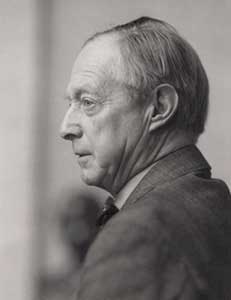
Sir Alfred Munnings
National Portrait Gallery |
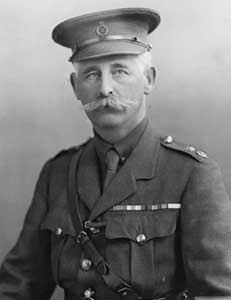
Colonel Sir George Holford
Imperial War Museum |
As for Paddy II himself, regimental records state that he began his career as a drum horse with the 1st Life Guards in 1916, survived being bowled into the Queen Victoria Memorial fountain by the future Oscar winner, Trooper Alfred Jones of The Blues aka Ray Milland, as I record in The Drum Horse in the Fountain (Nine Elms Books, 2018), and that he remained in service until 1929. The Kettledrummer in the painting is George Carter, who was appointed Kettledrummer of the 1st Life Guards on 4th July 1919 and, like his mount, remained with The Life Guards after the unhappy amalgamation of the 1st and 2nd Regiments in 1922. However, Carter retired before Paddy II on 8th May 1927, handing over the horse’s reins to Kettledrummer John King.
But what of the drum horse’s and the painting’s generous donor, Lieutenant Colonel Sir George Holford, a character now largely forgotten but a man of considerable historical significance who, along with Paddy II, is also featured in The Drum Horse in the Fountain. Born in 1860, George Holford was the fourth child and only son of Robert Holford, reputed to be the richest commoner in England. The family owned Westonbirt House in Gloucestershire (now a private school), along with 16,000 acres of Gloucestershire; Dorchester House on Park Lane (now the site of the Dorchester Hotel); and a museum-standard collection of books and fine art.
After Eton, in 1880 George was commissioned into the 1st Life Guards where, despite a generous allowance and prior to inheriting his father’s fortune in 1892, he quickly ran up large gambling debts. Eight years after joining the Regiment, he was appointed Equerry to HRH The Duke of Clarence, then the Heir Presumptive, and with breaks to fight in the Second Boer War, to command the 1st Life Guards in 1908 and the Reserve Regiment during the First World War, George remained in royal service until his death in 1926.
Although he inherited, along with enormous wealth, a great art collection, George’s principal non-military interests were in high-stakes backgammon (at which he later played with considerable skill but, displaying the largesse of great wealth, never collected his winnings), the development of a tree collection at Westonbirt, which is now the National Arboretum, and the cultivation of rare orchids (resulting in literally hundreds of hybrids still available today).
Despite being highly eligible marriage material, George showed little interest in the opposite sex until in 1912 when, aged 52, and to the considerable surprise of Society mamas who had long since written him off as ‘not the marrying kind’, he wed a wealthy widow, Mrs Suzannah Menzies. This liaison, which produced no children, did, however, give George a direct connection to a notorious royal scandal and one of the most important technical breakthroughs of the twentieth century, for Suzannah was the daughter of Arthur Wilson, the nouveaux riches owner of Tranby Croft, the site of the infamous Royal Baccarat Scandal of 1890, which is the subject of Royal Betrayal by former Scots Guardsman, Major General Mike Scott CB CBE DSO. She was also the mother of Major General Sir Stewart Menzies KCB KCMG DSO MC a Grenadier turned 2nd Life Guard who, in 1939, was appointed Chief of the Secret Intelligence Service (MI6). In that role, Menzies was not only the model for Ian Fleming’s ‘M’, but ensured that Alan Turing was able to perfect the computer which cracked the Germans’ Enigma codes.
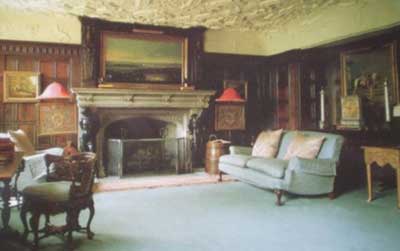
The Oak Room at Anglesey Abbey, showing the smaller
picture of The Drummer
|
When I was commissioned into The Life Guards, one of the first treasures that I admired in the Officers’ House was the Munnings Drum Horse. At the time, I was reliably informed that this was, in fact, the second painting of Paddy II and that the first had been rejected by the officers as being too small, a case of ‘looking a gift horse in the mouth’, if ever there was one. In researching my lecture for the National Army Museum, I established that this story was rubbish, although it did contain an element of truth, as there are indeed two versions of the painting, one of which is the working sketch from which Munnings later developed the larger canvas. Sir George purchased both from the artist in 1922 but retained the sketch. This was bought from his estate in 1928 by Huttleston Broughton (later Lord Fairhaven) another, even richer 1st Life Guard whose American father had made a fortune out of mining, railways and sewerage and whose maternal, oil magnate, grandfather was reputed to be one of the wealthiest men in the world. Unlike the final version, which is not on public view, the smaller oil sketch can be seen in the Oak Room at the National Trust’s Anglesey Abbey, formerly the home of the Fairhavens.
This article is based on a talk given by Christopher Joll at the National Army Museum in 2018.
Christopher Joll served in The Life Guards from 1968 to 1975. He died on 18th April 2024, aged 75. He is the co-author, with Anthony Weldon, of The Drum Horse in the Fountain & Other Tales of the Heroes and Rogues in the Guards, published by Nine Elms Books. Christopher’s obituary appeared in the Summer 2024 edition of The Guards Magazine.
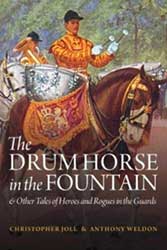
The Drum Horse in the Fountain & Other Tales of the Heroes and Rogues in the Guards, by Christopher Joll and Anthony Weldon |
|
|